By Bryan Martin - founder of RektRadar. Ethereum scam-detection infrastructure since 2024. GitHub - LinkedIn.
Two months ago I published We analyzed 78,723 Ethereum tokens. 46% were scams. It was an honest count straight out of our token_analysis table: 36,263 of 78,723 contracts scored 70 or above on our risk scale.
I re-ran the same query today. The table now holds 112,114 distinct Ethereum contracts - 33,391 more than in May. And the headline number moved a lot: 67,085 of them, 59.8%, are scams. Up from 46.1% in nine weeks.
But the all-time average buries the real story. The tokens deployed since that May post are 76.4% scams. Here is the breakdown.
Dataset snapshot
Snapshot: 2026-07-17. Same table, same 70+ risk threshold as the May post. The pipeline itself gained detectors in between (a section below owns that), so read the comparison as directional, not laboratory-clean.
- Total analyzed: 112,114 (was 78,723 on 2026-05-14)
- Scams (risk >= 70): 67,085 = 59.8% (was 36,263 = 46.1%)
- Critical (risk >= 90): 5,666
- New since 2026-05-14: 31,172 contracts, 76.4% scams
The all-time rate went up because the new rate is much higher
The 46% figure from May was an all-time average. It was held down by a large March backfill - 48,410 older, historical contracts that scored a comparatively tame 41.9%. Those are legacy tokens from a calmer era of the chain.
Split the table by when each contract was analyzed and the picture is different:
- Everything analyzed before 2026-05-14: 80,943 contracts, 53.5% scams
- Everything analyzed since 2026-05-14: 31,172 contracts, 76.4% scams
Three out of four tokens launched into our pipeline over the last two months are scams. The 46% number was never wrong; it was just averaging a scammy present with a cleaner past.
The monthly rate is climbing
Bucket the scam rate by the month each contract was analyzed and the trend is a staircase:
- February: 58.2% (7.8k tokens)
- March: 41.9% (48k tokens - the historical backfill)
- April: 75.7% (16k)
- May: 70.4% (18k)
- June: 78.5% (15k)
- July: 82.8% (7.3k so far)
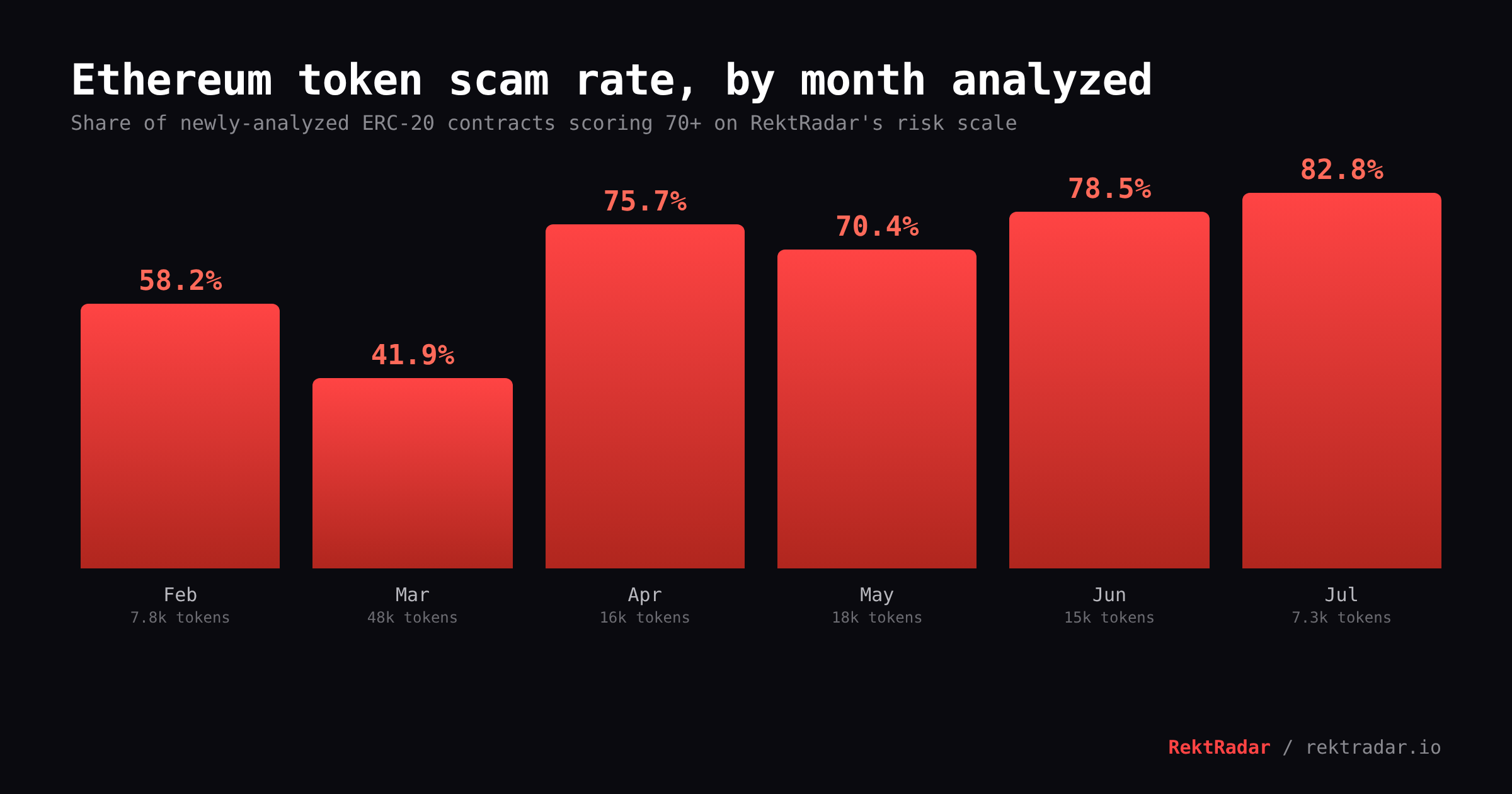
Ignore March (a one-off dump of old contracts) and the real-time months run 70% to 83%, trending up. In July, more than four in five newly-analyzed Ethereum token contracts are scams.
Is it more scams, or a sharper detector? Both.
Honesty check: some of that jump is us, not them. Two things about our scorer changed since May.
We added flags. A scam contract analyzed since the May post carries 11.06 risk flags on average, versus 8.27 before - a 34% richer fingerprint. New detectors landed in between: serial-scammer bytecode (7,370 contracts), known drainer-kit bytecode (8,082 contracts), hidden kill-switches, and more. Because our score floors on flag count - six independent flags force a 70 - catching more flags on the same behaviour pushes more contracts over the scam line.
We re-score, and we catch late rugs. Roughly 30% of the table gets re-analyzed at least a day after its first pass. A token can look clean at launch and pull its liquidity a week later; the second pass sees the rug and moves it from clean to scam. So a contract that counted as safe in May can be a confirmed scam in July without a single new scam being deployed.
So the 46-to-60 climb is not one number, it is three overlapping ones: more scams launching, a detector that flags more of them, and late rugs that only reveal themselves on a second look. We can not cleanly separate the three, and it would be dishonest to claim it is purely a scammier chain. But a fixed 70+ threshold, with every real-time month landing between 70% and 83%, is hard to explain by scoring changes alone.
Where the 112,114 land on the risk scale
| Bucket | Count | Share | What it means |
|---|---|---|---|
| 90 - 100 (critical) | 5,666 | 5.1% | Multiple independent signals agree. Almost always a honeypot or owner-controlled rug. |
| 70 - 89 (high-risk) | 61,420 | 54.8% | At least 3 strong red flags. The bulk of what we call “scams”. |
| 40 - 69 (borderline) | 35,145 | 31.3% | Some flags, not conclusive. Trade with caution. |
| 0 - 39 (low-risk) | 9,884 | 8.8% | Clean on our checks. Still not financial advice. |
Who is on the other side of these tokens
A scam contract is only half the story - someone has to lose money to it. We now trace that too. Across the chain we have resolved 5.26 million scam-token transactions back to their senders, which come out to 441,762 distinct victim wallets (386,355 once you strip the sniper bots that trade every fresh pool). That is the human cost behind the 67,085 scam contracts.
What we shipped to keep up
The scam rate did not climb in a vacuum; the techniques got better, so we added detectors:
- Hidden kill-switches - an obfuscated per-transfer call to one operator contract that decides who can trade. We now flag the shared bytecode marker. Full breakdown.
- Serial-buyer fingerprinting - the coordinated bot fleets that fake a pool’s early demand, so a “busy” launch does not read as organic.
- The funding graph - tracing a deployer’s wallet network in 3D, and a wallet check that walks your own address downstream to the scams your ETH reached.
Limits of our data
- Scorer-conditional. “Scam” means our multi-flag scorer put the contract at 70+. It has false positives and false negatives like any classifier; the percentages are “share our pipeline flags”, not ground-truth fraud.
- Selection bias. Contracts enter the table via mempool-watcher and factory-watcher - tokens that launch a DEX pair. A contract that never touches Uniswap is never scored, so this measures the population of tradeable new tokens, which skews scammy by nature.
- The month buckets are analysis dates, not deploy dates. A backfill (like March) mixes old contracts into a recent bucket. We call that out rather than smooth it over.
- Snapshot drift. These are counts on 2026-07-17. Re-run them next month and they will move again - probably up.
TL;DR
- The
token_analysistable went from 78,723 to 112,114 contracts in two months. - All-time scam rate: 46.1% -> 59.8% - a mix of more scams launching, a detector that now averages 11 flags per scam (up from 8), and late rugs caught on re-analysis (~30% of the table is re-scored). Not one cause; three.
- Of the 31,172 tokens deployed since the May post, 76.4% are scams; the monthly rate hit 82.8% in July.
- 441,762 distinct victim wallets traced across 5.26M scam-token transactions.
Update: r/ethereum pushed back on this post - was the rise real, or just our detector drifting? We froze a cohort of 25,931 tokens and ran the test: what r/ethereum taught us. 48.8% scam at deploy, 90.6% by day 30, zero flips back to clean - the rise is late rugs, not drift.
Check any token before you buy - free, no signup, no card. Paste a contract and see the verdict in seconds.