By Bryan Martin - founder of RektRadar. Ethereum scam-detection infrastructure since 2024. GitHub - LinkedIn.
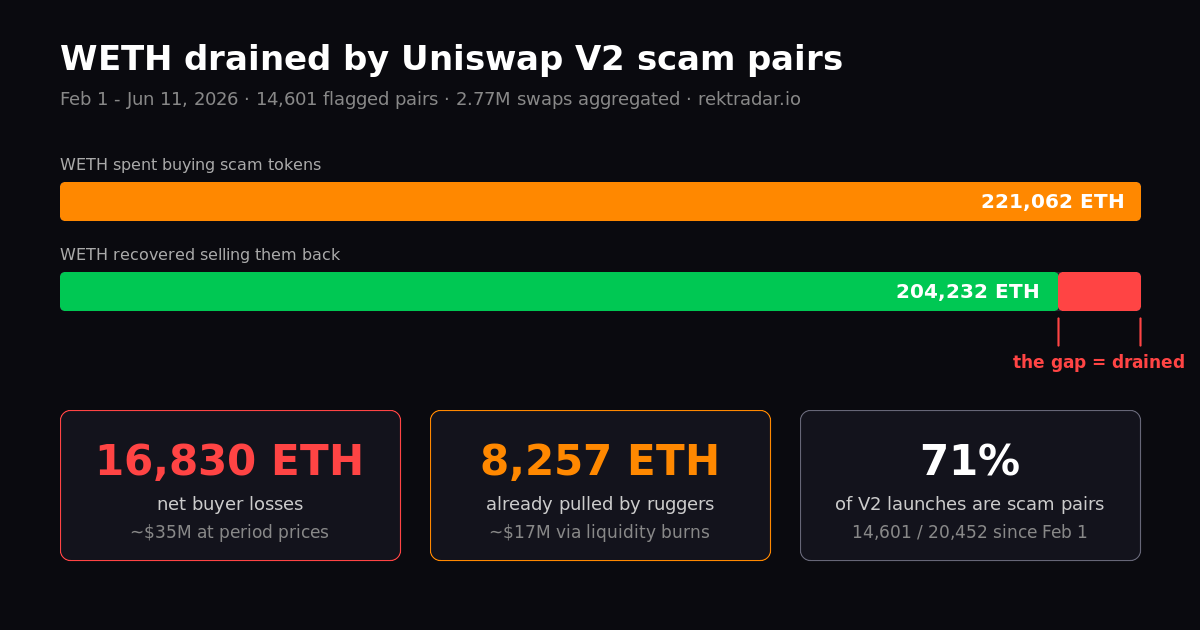
“How much money do these scams actually steal?” is the question we get most, and most answers out there are extrapolations. We decided to answer it the hard way: by summing every swap, every liquidity mint and every liquidity burn on every Uniswap V2 pair our infrastructure has watched since it went live.
The result: in 4.5 months, buyers collectively lost a net 16,830 ETH (~$35M at the period’s average price) inside V2 pairs whose token our scoring pipeline flags as a scam. Ruggers have already extracted 8,257 ETH (~$17M) of it through liquidity pulls. And the single most uncomfortable number: 71% of all Uniswap V2 pair launches we observed were scam pairs.
This is not a model and not a projection. It is SQL over our own event log.
Dataset snapshot
Snapshot: 2026-06-11. Source: RektRadar’s events table (29.1M decoded on-chain events captured live since 2026-02-01 by our factory and mempool watchers) joined with token_analysis (93,691 tokens fully scored by the 9-dimension pipeline).
- N_total: 20,452 distinct Uniswap V2 pairs created between 2026-02-01 and 2026-06-11
- N_filtered: 14,601 pairs (71.4%) pairing WETH with a token scoring >= 70 on our risk scale
- Events aggregated on those pairs: 2,770,692 swaps + 46,625 mints + 44,354 burns (deduplicated)
- Key metric: 16,830 ETH net buyer losses, 8,257 ETH net extracted by liquidity pulls
The headline numbers
| Metric | ETH (WETH) | USD at period avg (~$2,105) |
|---|---|---|
| WETH spent buying scam tokens | 221,062 | $465M |
| WETH recovered selling them back | 204,232 | $430M |
| Net buyer losses | 16,830 | ~$35.4M |
| Gross buyer losses (losing pools only) | 23,207 | ~$48.9M |
| WETH seeded by deployers (mints) | 16,123 | $33.9M |
| WETH pulled out via burns | 24,380 | $51.3M |
| Net extracted by ruggers | 8,257 | ~$17.4M |
ETH traded between $1,569 and $2,421 over the window, averaging $2,105. At today’s price ($1,661) the net buyer loss is “only” $27.9M, which says more about ETH than about the scammers.
Where the money sits: a pool is a closed box
A Uniswap V2 pair only has four doors for WETH: swaps in, swaps out, liquidity mints, liquidity burns. That makes the accounting honest. Per pool:
- Net buyer losses = WETH in via buys - WETH out via sells. This is what traders collectively left inside.
- Net extracted = WETH burned - WETH minted. This is what liquidity providers (on a scam pair, the scammer) walked away with beyond their initial seed.
The two numbers bracket the theft. Buyers left 16,830 ETH in the boxes; ruggers have already carried 8,257 ETH out the liquidity-removal door; roughly 8,573 ETH is still sitting inside flagged pairs or left through paths we do not attribute (scammer self-dumps count as ordinary sells in our sums, so the real victim losses are higher, not lower).
The long tail: the median rug steals 0.21 ETH
13,247 of the flagged pairs had at least one swap. 9,295 of them (70%) ended net-negative for buyers. But the median net loss per pool is just 0.21 ETH (~$440).
The Ethereum scam economy is not a few heists. It is an industrial long tail of micro-rugs: deploy a token for pennies, seed 0.5 ETH of liquidity, catch a handful of snipers and tourists, pull, repeat. Our serial scammer wallet anatomy post shows the same pattern from the deployer side; this is what it adds up to on the victim side.
The top 10 pools account for roughly half of all net inflows. Concentration at the top, industrial volume at the bottom.
The biggest drains
| Token | Risk score | Net buyer inflow (ETH) | Liquidity pulled? |
|---|---|---|---|
| $ZAYU | 80 | 2,900 | not yet |
| $KNX | 85 | 1,745 | not yet |
| ETHX | 80 | 999 | not yet |
| RISE | 80 | 648 | not yet |
| DU | 85 | 581 | not yet |
| OPNTR | 70 | 419 | yes - 412 ETH out |
| CCLS | 80 | 333 | yes - 330 ETH out |
The “not yet” rows are the chilling part. The largest flagged pairs still hold their liquidity: thousands of ETH of buyer money sitting in tokens our pipeline scores 80+, one transaction away from extraction. OPNTR and CCLS show what that transaction looks like: when the pull comes, it takes essentially everything.
Why we excluded Uniswap V3 (and you should distrust V3 “stolen” stats)
We ran the same aggregation on 3,869 flagged V3 pools and got numbers that violate conservation: 487,266 WETH burned out of pools that only ever received 315,582 via mints and 2,299 net via swaps. Impossible - unless WETH enters pools through untracked direct transfers, which is exactly what liquidity-cycling and wash-trading setups do.
Two tokens (uPEG and ASTEROID) account for 72% of that fake volume, with hundreds of thousands of ETH churned in and out as LP positions. None of it is victim money. Any “X million stolen” figure built naively on V3 burn events will be inflated by an order of magnitude. Scams launch on V2; V3 is where volume-faking lives.
Methodology
- Scam set: tokens with
risk_score >= 70intoken_analysis(42,796 of 93,691 analyzed - the threshold and pipeline are detailed in our 78k-token breakdown). - Pool set: V2
pair_createdevents where one side is canonical WETH and the other side is in the scam set. - Aggregation: per pool, sum the WETH legs of
swap(amountIn/amountOut),mintandburnevents, deduplicated on(tx_hash, log_index)because our pipeline writes both pending and confirmed states. - Totals: net figures sum all pools; gross figures sum only pools where the per-pool net is positive (so winners do not mask losers).
The full analysis (SQL included) lives in our infra repo, and the aggregate is now exposed live: the same numbers power the “all time” counter on rektradar.io and refresh every 6 hours.
Limits of our data
- Scorer-conditional totals. “Scam pair” means “paired with a token our multi-flag scorer puts at 70+”. False positives inflate the totals; false negatives (scams we scored under 70) deflate them. Our precision/recall audit suggests the two do not cancel neatly.
- Net != victim losses. Scammer self-dumps are indistinguishable from ordinary sells in pool-level sums, so net buyer losses understate what real victims lost. Winning snipers also capture part of the flow: not all of it ends in scammer wallets.
- Sampling window and scope. 2026-02-01 to 2026-06-11, Ethereum mainnet, Uniswap V2 WETH pairs only. No V3/V4 (see above), no stablecoin-quoted pairs, no other DEXes, no L2s. The true ecosystem-wide figure is strictly larger.
- Still-live pools can move. ZAYU-style pairs holding thousands of ETH may still rug (raising extraction) or, rarely, turn out legitimate (lowering losses). The 6-hourly recompute will track it.
TL;DR
- 71% of the 20,452 Uniswap V2 pairs launched since February pair WETH with a token we flag as a scam (risk >= 70)
- Buyers net-lost 16,830 ETH (~$35M at period prices) inside those pairs; gross losses on losing pools: 23,207 ETH
- Ruggers already extracted 8,257 ETH (~$17M) via liquidity pulls; ~8,500 ETH of buyer money still sits in flagged pairs
- The median rug nets just 0.21 ETH - it is an industrial long tail, not a few heists
- V3 burn-based “stolen” stats are inflated by LP churn and wash trading; we measured and excluded it
Try the free scan, no signup, no card - the 14,601 pairs in this post were all flagged automatically before most of them had their first victim.